Creatine has long been associated with athletes, bodybuilders, and sports-performance products. That positioning is undergoing a major shift.
Women, particularly those navigating midlife, are increasingly considering creatine in connection with cognitive health, sustained energy, muscle maintenance, recovery, and healthy aging.
The opportunity is substantial. Capturing it, however, requires brands to understand not only that women are interested in creatine, but how that interest develops.
CPG Radar’s analysis reveals a journey that often begins with broad, gender-neutral discovery and becomes more personal over time. Women may first ask whether creatine works. Later, they ask whether it works for someone like them.
Creatine is capturing an outsized share of attention
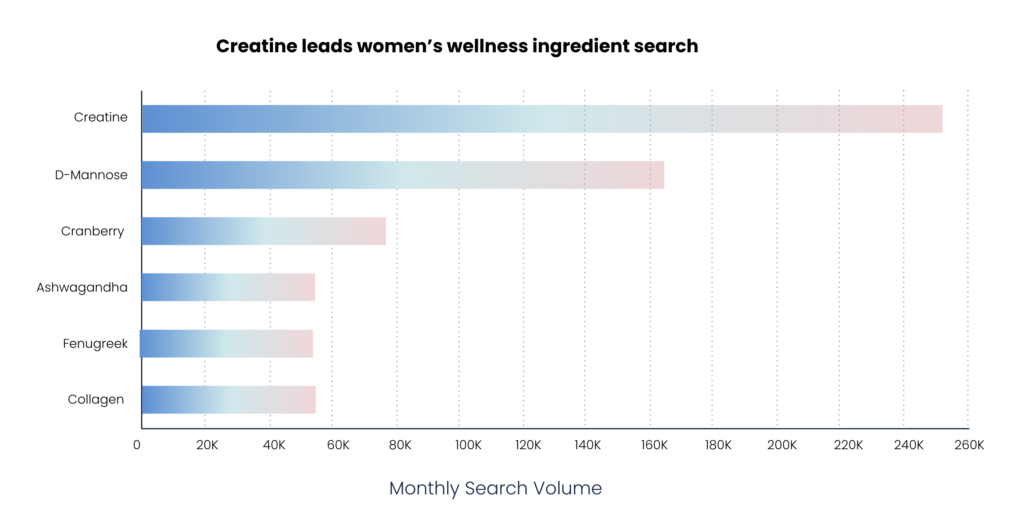
CPG Radar analyzed 544 ingredients associated with the women’s health category. Together, those ingredients generate approximately 1.35 million searches per month.
Creatine accounts for more than 250,000 of those searches, or 18.7% of the total ingredient search volume analyzed. Annualized, that represents nearly 3 million searches.
Its trajectory is equally notable. Among the meaningful-scale ingredients included in the analysis, creatine was the only one to show 100% year-over-year search growth. Several established women’s wellness ingredients, including collagen, magnesium, and maca, declined over the same period.
This does not mean creatine will replace those ingredients or serve the same needs. It does indicate that attention is shifting—and that creatine is expanding beyond the market where brands have historically positioned it.
A broader set of needs is reshaping the category
Strength and exercise performance remain part of creatine’s appeal. But women’s conversations increasingly connect it with cognitive clarity, everyday energy, recovery, menopause, and long-term wellness.
This broader benefit set makes creatine relevant to consumers who may not identify as athletes. They may encounter the ingredient while looking for help with brain fog, afternoon fatigue, changing body composition, or difficulty maintaining muscle with age.
The opportunity is therefore larger than selling an established sports ingredient to a new demographic. Creatine is beginning to occupy a different role within women’s wellness: one connected to maintaining function through changing life stages.
She talks specifically, but searches broadly
Women’s conversations about creatine often contain significant personal context. They reference age, perimenopause, menopause, postmenopausal health, changing energy levels, or difficulty maintaining strength.
Their initial searches are usually broader.
Early in the journey, women often use gender-neutral terms as they establish a basic understanding of creatine. They want to know what it does, whether it works, how it is used, and whether it belongs in their routine.
Only later do their questions become more specific to their bodies and life stages.
Discovery begins with validation
During discovery, the consumer is not necessarily comparing brands. She is first deciding whether creatine is credible and relevant.
Her questions are foundational:
What does creatine do?
Is it only for athletes?
How much should I take?
When should I take it?
Is it appropriate for regular use?
At this stage, clear education may be more valuable than highly differentiated product language. Brands need to appear in broad creatine discovery without relying exclusively on traditional sports-performance framing.
A consumer looking for support through midlife may begin with the same search as an athlete, but she is evaluating the information through a different set of needs.
Podcasts are accelerating creatine awareness
In 2025, nearly 470 podcast episodes focused on creatine. Approximately one in six used prescriptive language in their titles, including phrases such as “must” or “need to be taking creatine.”
That reflects a broader cultural shift. Creatine is increasingly presented not as a specialized performance aid, but as a foundational wellness consideration.
Podcasts help consumers connect emerging science with recognizable concerns such as brain fog, fatigue, muscle maintenance, and healthy aging. But cultural enthusiasm also raises expectations.
After hearing a confident recommendation, consumers still need practical guidance: which product to choose, how to use it, and what results are reasonable to expect.
Awareness creates the opening. Brands must provide the clarity that follows.
From broad awareness to personal relevance
Creatine’s momentum in women’s wellness is supported by a clear demand signal: substantial search volume, strong growth, and an expanding cultural conversation.
But growth alone will not determine which brands benefit.
Women often enter the category through broad discovery before connecting creatine to specific life-stage needs. Brands must therefore operate at both levels: making the ingredient understandable to newcomers while demonstrating its relevance to women seeking cognitive support, energy, strength, recovery, or long-term wellness.
The next phase of the market will not be defined simply by putting creatine in women-focused packaging. It will be defined by how effectively brands translate broad awareness into personal relevance.
Book a demo with a CPG Radar representative to find your next market opportunity.
on demand
The Creatine Blind Spot: The Women’s Wellness Opportunity Brands Are Missing
Creatine is one of the most studied and widely used ingredients in supplements, but nearly all of its innovation and positioning remains anchored in sports nutrition. At the same time, consumer behavior is shifting in a way the market has not caught up to, with women now driving the majority of search interest around creatine, while almost no products are designed specifically for them.
In this session, we’ll break down how this gap exists, and why it’s invisible to most brands. We’ll show how one of the most established ingredients in the industry is quietly becoming one of the largest untapped opportunities in women’s wellness.
We’ll then translate these insights into concrete product concepts, formulation strategies, and positioning angles that brands can act on immediately.
What You’ll Learn
The Hidden Demand Shift in Creatine: Why women now represent the majority of creatine-related search interest, and what that signals about where the category is moving.
Why Brands Haven’t Moved (Yet): The structural reasons incumbents remain anchored in sports nutrition, and why that creates a window for new entrants.
The Barrier No One Is Addressing: How concerns like bloating and water retention are shaping adoption.
Winning Product & Formulation Strategies: What the data suggests around…
Format (capsules vs. powders)
Dose strategy
Claim construction grounded in clinical evidence
How to Enter Before Incumbents Do: A practical approach to building a defensible position before large brands reposition and close the gap.
Who Should Attend?
Product Development Leaders: Looking to unlock new growth platforms using proven ingredients in underdeveloped categories.
Brand Leaders & Innovation Teams: Seeking differentiated positioning in crowded markets like sports nutrition and longevity.
Ingredient Suppliers & Commercial Teams: Wanting to reframe how creatine (and similar ingredients) can be positioned to new audiences.
Marketing & Strategy Teams: Responsible for translating clinical evidence into messaging that resonates with specific consumer segments.
GLP-1 medications have reshaped weight management, but they’ve also created a set of predictable, under-addressed consumer challenges. GLP-1 users follow a predictable, multi-phase journey, creating distinct product needs at each stage of treatment.
In this webinar, we’ll show how search behavior, real consumer experience, and clinical research align to reveal where supplement products can play a credible, defensible role as GLP-1 companion products. This session is not about chasing trends. It’s about designing products and portfolios that match how GLP-1 users actually experience the journey.
What You’ll Learn
In this session, you’ll learn:
Why GLP-1 is not a single product opportunity, but a multi-phase consumer journey spanning initiation, titration, transformation, maintenance, and discontinuation
Which GLP-1 side effects and concerns are both highly searched and clinically substantiated, and where brands should be cautious
How current GLP-1 companion products are being positioned, and where true white space still exists
What a multi-phase product strategy looks like in practice, including implications for formats, claims, and portfolio design
How to think about GLP-1 companions as a long-term growth platform, not a short-term trend tied only to active medication use
Who This Webinar Is For
This webinar is designed for:
Product development, innovation, and R&D leaders at supplement brands
Marketing and brand teams evaluating GLP-1 companion positioning
Commercial and strategy leaders assessing GLP-1 as a portfolio-level opportunity
Ingredient suppliers supporting customers in GLP-1–adjacent innovation
About the Host
Afif Ghannoum is the Founder and CEO of CPG Radar, a market intelligence platform used by leading supplement brands and ingredient suppliers to guide product innovation and go-to-market strategy.
Afif works at the intersection of consumer search behavior, clinical research, and competitive market dynamics. He has led GLP-1 landscape analyses for multiple partners, helping teams understand where demand, science, and defensible product opportunities truly align.
To provide the best experiences, we use technologies like cookies to store and/or access device information. Consenting to these technologies will allow us to process data such as browsing behavior or unique IDs on this site. Not consenting or withdrawing consent, may adversely affect certain features and functions.
Functional
Always active
The technical storage or access is strictly necessary for the legitimate purpose of enabling the use of a specific service explicitly requested by the subscriber or user, or for the sole purpose of carrying out the transmission of a communication over an electronic communications network.
Preferences
The technical storage or access is necessary for the legitimate purpose of storing preferences that are not requested by the subscriber or user.
Statistics
The technical storage or access that is used exclusively for statistical purposes.The technical storage or access that is used exclusively for anonymous statistical purposes. Without a subpoena, voluntary compliance on the part of your Internet Service Provider, or additional records from a third party, information stored or retrieved for this purpose alone cannot usually be used to identify you.
Marketing
The technical storage or access is required to create user profiles to send advertising, or to track the user on a website or across several websites for similar marketing purposes.